
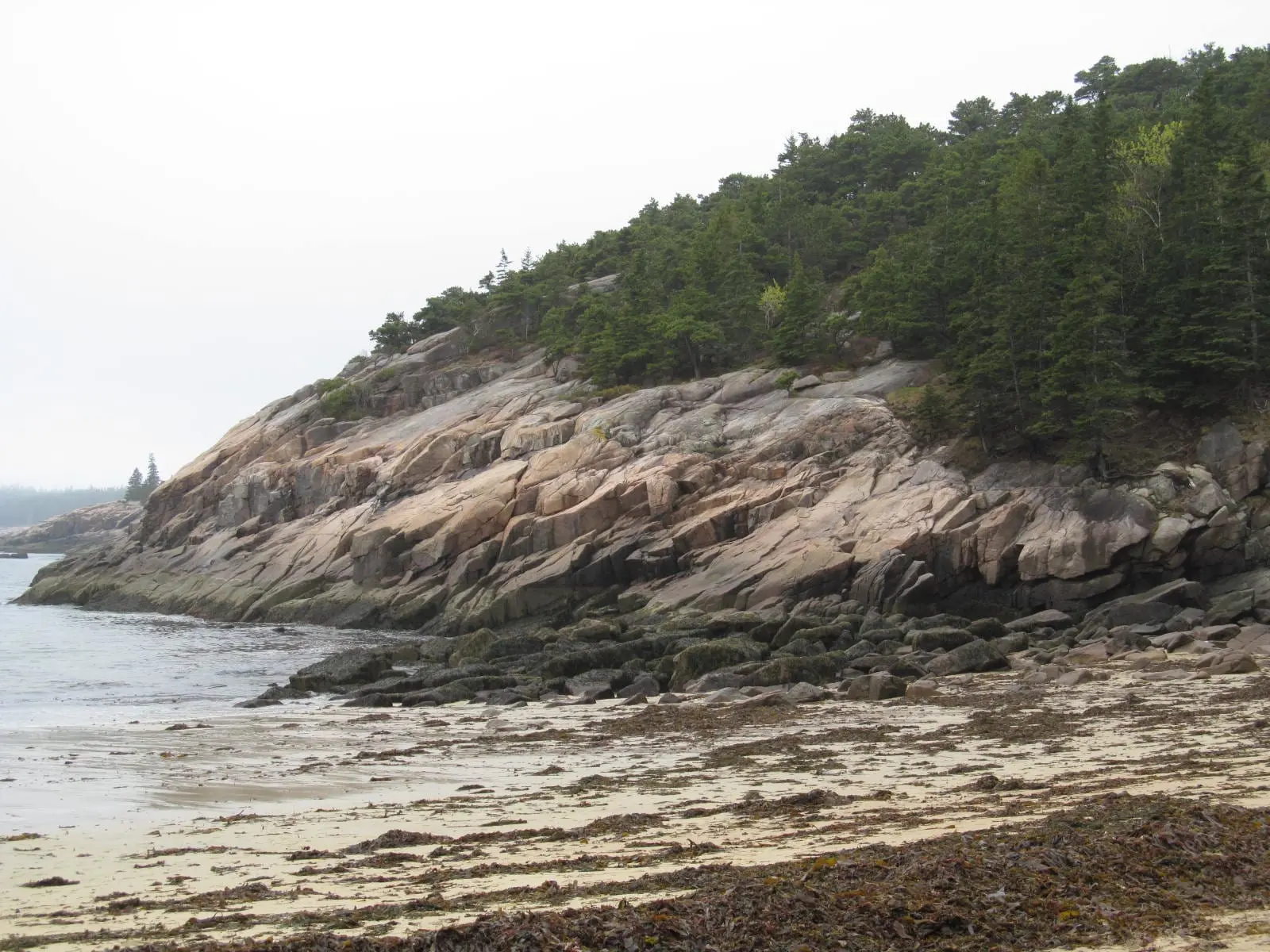

Sand Beach is the largest sandy beach in Acadia, which the Park Service is careful to describe as a small stretch of coast. Both halves of that are true. It is the beach on Mount Desert Island, and it is not large.
Two numbers decide your morning
The lot fills by 9 a.m. in peak season. When it does, cars park along Park Loop Road and everyone walks in from wherever they stopped.
The water runs 50 to 60°F. The Park Service’s own words are that it “can be shockingly cold, even in summer.” It is the same water a sea kayak sits in, which is why the park keeps unguided ocean kayaking for experienced paddlers — the kayak tours and the cold-water rules.
The first number is why you either arrive early or do not drive at all. Two free buses reach it, until 12 October in 2026:
- Island Explorer Route 3, Sand Beach, runs direct from the Bar Harbor Village Green, the obvious one if you are staying in town. In the fall the last bus leaves the Green at 3:50 p.m. and the last one back leaves Sand Beach at 4:20 p.m. (timetable).
- Route 4, the Loop Road, runs to Sand Beach through the day from the Visitor Center or Sieur de Monts and stops at the Island Explorer sign at the edge of the parking lot.
The bus does not care whether the lot is full, and on an August morning it is simply the better way to get there.
Out of the bus season you drive to it, and you can all winter: Ocean Drive, the stretch of the Loop Road past the beach, is one of the two sections the Park Service keeps open to cars from 1 December to 14 April, weather permitting (Acadia in winter).
The second number is why the beach is busy and the water is not.
Check the board before you change
There is a bulletin board by the parking lot with the day’s water temperature on it.
That is a small, genuinely useful thing almost nobody mentions. Sixty degrees and fifty degrees are different decisions, and you can find out which one you are facing before you have committed to anything.
The safety warning is not boilerplate
The Park Service gives two, and they are worth repeating exactly:
- The water “can be shockingly cold, even in summer.”
- “Strong tides and rogue waves can surprise even experienced swimmers.”
Cold water takes your breath before it takes your strength, which is the mechanism that gets competent swimmers into trouble on a calm-looking day. Do not count on a lifeguard. The Park Service’s swimming page states it without qualification — “Lifeguards are not present at Sand Beach” — while other Park Service pages describe seasonal staffing. Three of its pages, three answers, which is a good reason to take the one that assumes nobody is watching. Plan the swim as an unsupervised one and you cannot be wrong.
The lagoon is a separate warning. On 23 September 2026 the Park Service had a public health advisory posted for Sand Beach Lagoon: bacterial levels exceeded public health standards, and it advised against water contact until they returned to healthful levels. By 4 October the advisory no longer appeared in the park’s alert feed, which lists only current alerts, so it has probably ended; the park’s conditions page is where a new one would be posted. The advisory was for the lagoon, not for Sand Beach.
What is actually there
Bathrooms and changing rooms, both with wheelchair-accessible stalls, low foot-rinsing faucets, and water fountains, reached by a wide asphalt path with wooden railings.
The beach itself is not wheelchair accessible. It is reached by a staircase down the cliffside, and there is no way around that. If that matters for your group, the facilities and the view from the top are genuinely worth the stop, and the swim is not the point anyway.
Why most people are really here
The Beehive Trail starts across the road, and the granite dome you can see from the sand is the thing you would be climbing. Sand Beach is where you stand and decide whether the iron rungs are for you.
The gentler walk starts here too. Ocean Path leaves from the upper parking lot and runs 0.7 miles along the shore to Thunder Hole, on concrete and packed gravel.
Come early, take the bus, look at the board, and treat the ocean with more suspicion than a beach usually earns.


