
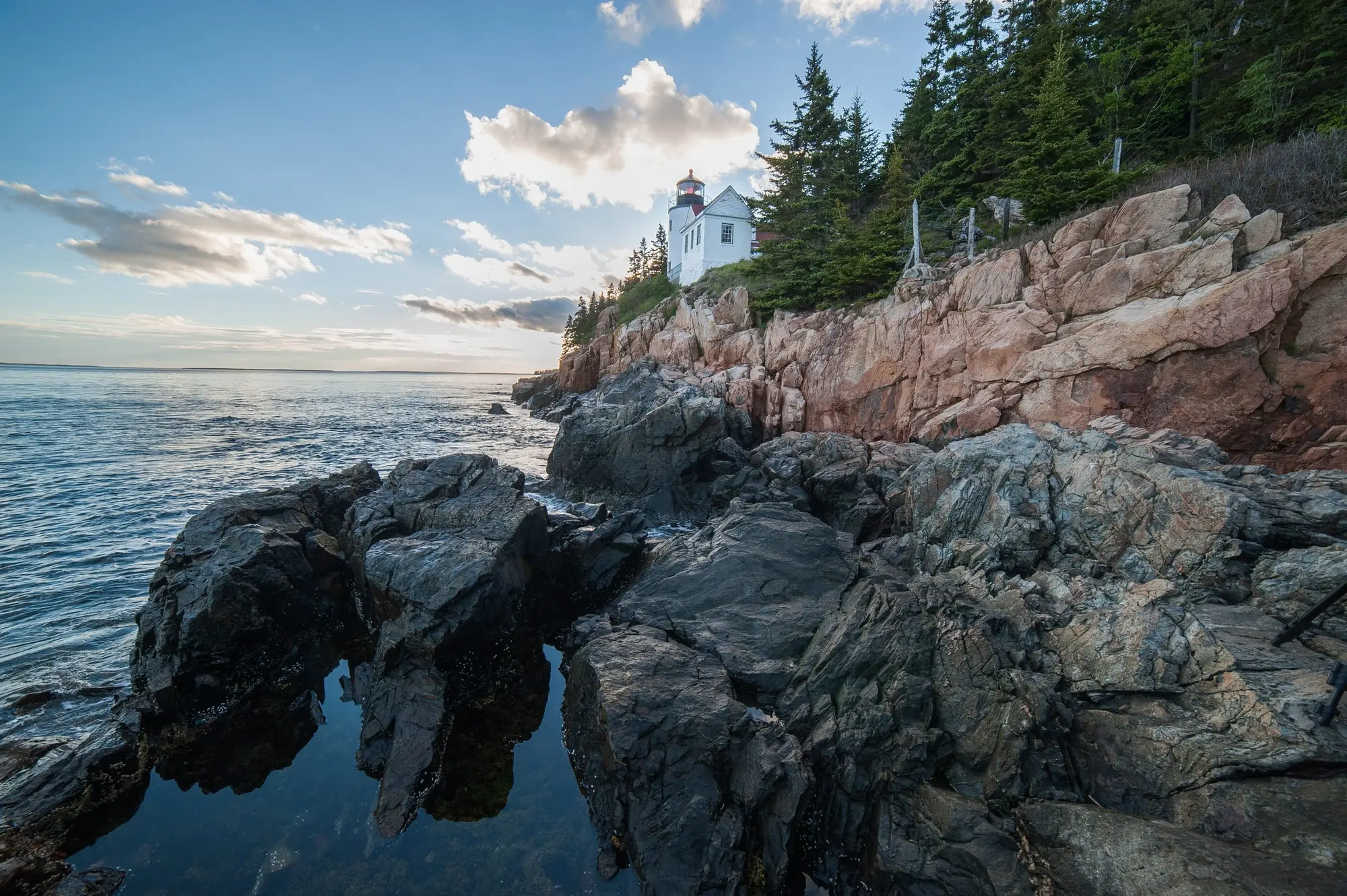

Go in the daytime if you want a parking space; go at sunset if you want the famous picture and can live with the crowd. The lighthouse on the southwest corner of Mount Desert Island gets about 180,000 visitors a year, by the Park Service’s count — the fifth busiest place in Acadia, after Cadillac, Jordan Pond, Sand Beach and Thunder Hole — and they share one lot of 27 spaces.
The parking problem, in the park’s words
The Park Service’s visitor page for the light is headed “Expect Sunset Gridlock, Lack of Parking”, and it does not soften it:
“Public parking is limited to a single, small lot. Open spaces may exist only during the day. Roadside parking is prohibited along the entrance road and 102A.”
Put together, that means a full lot is a closed lot. There is no overflow lot and no roadside parking to fall back on. At sunset you arrive early enough to get a space, or you leave and come back another day.
The rest of the rules, from the same page and the park’s place page:
- No bus. “Public transportation does not currently serve the site.” (The older visitor page still says the Island Explorer does not serve it “in 2021”; the newer place page, updated 19 September 2026, is the current word.)
- No buses, trailers or RVs, because of “the narrow entrance road and limited parking”. The same rule, and the 21-foot limits elsewhere in the park, are on the vehicle-length page.
- A park pass is required to park: “An Acadia National Park pass, or other valid National Park Service pass is required for parking.”
- Respect the neighbors. The Park Service asks visitors to respect neighbors and private property owners.
Sunset
The US Naval Observatory puts sunset at the light, on the first of each month, at:
| Date | Sunset | Civil twilight ends |
|---|---|---|
| 1 November 2026 | 4:23 p.m. | 4:53 p.m. |
| 1 December | 3:56 p.m. | 4:28 p.m. |
| 1 January 2027 | 4:05 p.m. | 4:38 p.m. |
| 1 February | 4:43 p.m. | 5:14 p.m. |
| 1 March | 5:21 p.m. | 5:50 p.m. |
| 1 April | 7:00 p.m. | 7:30 p.m. |
| 1 May | 7:37 p.m. | 8:09 p.m. |
| 1 June | 8:10 p.m. | 8:46 p.m. |
| 1 July | 8:21 p.m. | 8:57 p.m. |
| 1 August | 7:58 p.m. | 8:31 p.m. |
| 1 September | 7:10 p.m. | 7:40 p.m. |
| 1 October | 6:14 p.m. | 6:43 p.m. |
The clocks go back on 1 November 2026 and forward on 14 March 2027, which is why the March and April rows are more than an hour apart. In October 2026 the sun set there at 5:54 p.m. on the 12th and 5:24 p.m. on the 31st.
The park’s own photograph of the scene is captioned “Photographers jockey for spots along a rocky ocean coastline as sunset approaches.” That is the crowd to expect on the rocks, and the reason the lot fills before the sun goes down.
If the lot is full, two short walks on the same side of the island make good fallbacks: the Ship Harbor Trail, a 1.3-mile figure-eight from its own trailhead lot on Route 102A, which the Park Service calls great for families and birders, and Wonderland, a 1.4-mile round trip to the shore. Neither has a bus either.
For a sunset from the water instead, the boats and the times they actually meet the sun are on the sunset cruise page — in the fall, not every “sunset cruise” is still out when the sun sets, and every one of them had ended its 2026 season by 25 October.
The three viewpoints
The Park Service lists three, and they are very different walks:
- Accessible overlook — a packed-gravel viewing area right in front of the three accessible parking spaces, with views of the lighthouse and the coast. An accessible restroom is at the end of the lot.
- Lighthouse view — “A steep paved driveway leading to the lighthouse and an interpretive wayside exhibit.” The lighthouse itself is not open to the public.
- Cliff viewpoint — “A short gravel path followed by a wooden staircase (37 steps) and 27 wide stone steps leading to dramatic shoreline views.” This is where the postcard view is, looking back at the light from the rocks.
The rocks
The picture everyone wants is taken from the rocks below the light, and the Park Service’s general advice for Acadia’s shoreline applies here in full:
- “Black rocks and seaweed are especially slippery, and shells are hard and jagged.”
- “Use caution as rocks can be wet, loose, and/or sharp.”
- “Do not turn your back on the ocean in case of stormy weather and rogue waves.”
- “Be careful while walking near cliff ledges.”
Two things are particular to a sunset visit. The best light is also the last light, and civil twilight ends 29 to 36 minutes after sunset, so the climb back up 64 steps happens in the dusk — bring a headlamp. And the crowd on the rocks is at its thickest exactly when people are watching the sky, not their feet. Wear shoes with grip, and keep children within reach.
Getting there
By car only: Route 102A from Bass Harbor or from Seawall, then Lighthouse Road to the lot. The Park Service’s two pages disagree on that last stretch — a “quarter-mile entrance road” on one, “Lighthouse Road for 0.5 miles” on the other. Without traffic, it puts the light about 35 minutes from the Hulls Cove Visitor Center and 10 minutes from Seawall Campground. Seawall closed for the season on 12 October in 2026; it opened on 20 May.
It makes a natural half-day with the rest of the quiet side of the island — the three-day itinerary puts it on day three, and the Seal Cove Auto Museum, open daily from 1 May to 31 October and on Mondays and Tuesdays by appointment the rest of the year, is also in Tremont (what else is open, and until when). For a whole week on this side of the island, renting a cottage in Southwest Harbor or Bass Harbor has the towns, their rules and the buses that reached them.
The light itself
- Built in 1858. The newer place page says Congress appropriated $5,000 for it in 1855 and authorized construction in 1858; the visitor page says it was built in 1858 with funds Congress appropriated.
- A 37-foot tower, lightning rod included, with a 1901 lantern holding a fourth-order Fresnel lens. The light is “occulting red for four seconds and eclipsed for one second”, with a range of 13 miles.
- Park Service owned since 8 July 2020, when the Coast Guard transferred the station; the Coast Guard still runs the light. It then replaced the white lamp with a red LED, which let the red acrylic “chimney” around the lens come off.
- On the America the Beautiful quarter in 2012 and the Park Service’s centennial stamp in 2016, and on the National Register of Historic Places since 1988.


